What is CNC machining and why use it?

Understand how CNC machining works and the benefits it offers for producing technical parts with precision and consistency in series.
In summary
- CNCmachining is a computer-controlled manufacturing process used to produce parts with precision and consistency.
- It relies on several key steps: part design, machine programming, material machining and final inspection.
- The main CNC machining operations are milling, turning, drilling and tapping.
- This technology is widely used in the industry for its precision, repeatability, productivity and its ability to manufacture complex parts.
- For manufacturers, CNC machining ensures part quality while improving production reliability.
What is CNC machining?
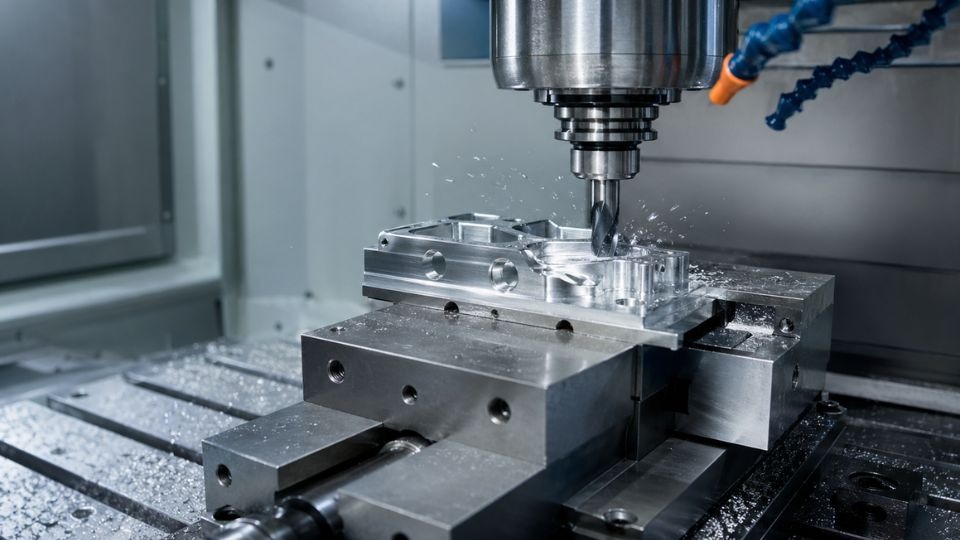
CNC machining is a manufacturing method that produces parts with remarkable precision using computer-controlled machines.
When a part must meet strict dimensions, fit perfectly into a mechanical assembly, or be reproduced multiple times without significant deviation, CNC machining becomes the go-to solution. It addresses a very practical industrial reality: producing accurately, producing well, and being able to repeat the process with the same high standards.
In practice, this technology is used to manufacture technical parts from various materials by automating operations such as milling, turning, drilling, and tapping.
You aren't just looking for a "modern" process. You are looking for manufacturing that can deliver on its promises: precision, repeatability, productivity, and control. This is exactly where CNC machining proves its worth, especially in sectors where quality is non-negotiable.
- You ensure precision for parts, even with demanding geometries.
- You achieve better repeatability, which is essential for prototypes, small batches, or recurring production runs.
- You reduce manufacturing variations, and therefore rework, wasted time, and avoidable defects.
- You improve industrial efficiency, with a process better suited to performance and quality requirements.
Good to know: At ZEDCE, we have been working on precision parts since 1946 and we rely on a broad value chain: machining, grinding, superfinishing, assembly, and treatment management.
How does CNC machining work?
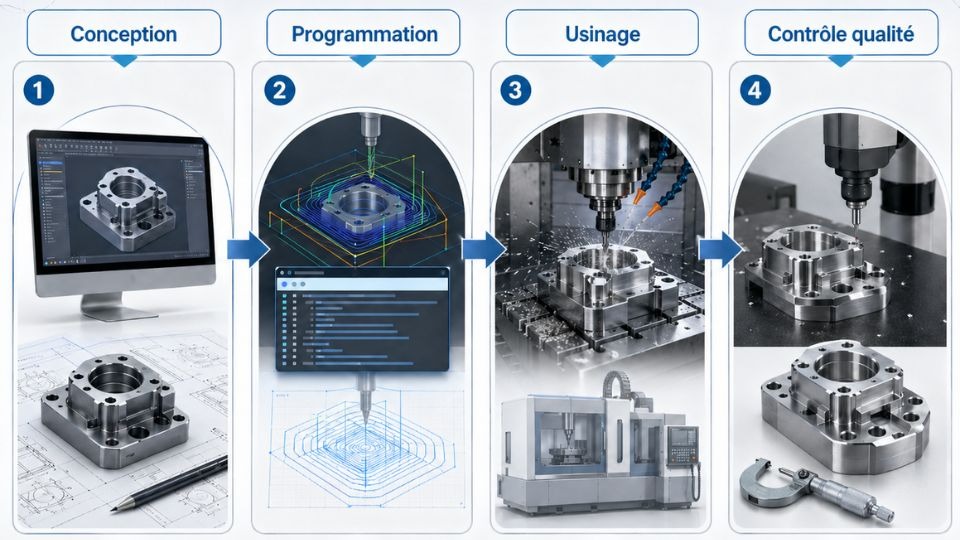
At first glance, CNC machining might seem highly technical. In reality, its operation is based on a simple logic: you start with a requirement, translate it into instructions, and then the machine executes the work with precision.
Before a part physically exists, it goes through several stages that secure its manufacturing. This process helps minimize improvisation, ensures consistency, and achieves a level of precision that is difficult to obtain manually.
In practical terms, the process generally follows this sequence:
- design the part based on a technical requirement,
- program the machine to define the operations to be performed,
- start machining to transform raw material into a finished part,
- inspect the result to verify its compliance.
Part design
Before discussing tools, cutting speeds, or materials, the part to be produced must be defined. Its dimensions, shapes, mechanical constraints, tolerances, and final use: all of this matters. The clearer this stage is, the smoother the subsequent manufacturing process will be.
A well-thought-out part is not only functional; it is also easier to machine, more compatible with machine capabilities, and often more cost-effective to produce.
Machine programming
Once the part is defined, the technical intent must be translated into a language the machine can process.
This is the role of programming. It defines trajectories, movements, cutting depths, the sequence of operations, and machining parameters. This phase is decisive, as it determines the final precision, cycle time, and process stability.
Automated execution of operations
Once the program is loaded, the machine goes into action.
It follows the prescribed instructions to remove material consistently, according to a precise sequence. Milling, turning, drilling, tapping: operations follow one another based on a pre-defined logic, without relying solely on human input at every moment.
This is what makes CNC machining so valuable in an industrial environment. You get stable execution, capable of repeating the same result across multiple parts, while maintaining high standards. And when a part features complex shapes or tight tolerances, this advantage becomes even more tangible.
Inspecting the finished part
A part may look correct but still fail to meet specifications. That is why final inspection is essential. It allows for the verification of dimensions, build quality, adherence to tolerances, and, more broadly, the alignment between the manufactured part and the initial requirements.
This step secures the entire process. It prevents discrepancies from going unnoticed, protects the expected quality, and reinforces production reliability. For you, this is a critical point because the true value of CNC machining lies in automation and the ability to produce a precise, inspected part ready for real-world use.
Good to know: We emphasize advanced metrology with CMM, machine vision, enhanced quality control, FAI (First Article Inspection) on initial production runs, and full traceability.
What are the main CNC machining operations?
CNC milling
The CNC milling involves removing material using a rotating tool. It is one of the most common operations for producing parts with flat surfaces, grooves, pockets, or more elaborate shapes.
Its main advantage is its versatility. Milling can meet a wide variety of needs, from simple parts to technical components with complex geometries. For you, this means true adaptability, especially when specifications require precision, repeatability, and controlled finishes.
It is also a particularly relevant process when multiple machining operations must be performed rigorously on the same part.
CNC turning
The CNC turning process is particularly well-suited for cylindrical parts. In this case, the part itself is rotated while a tool precisely machines the material.
This process is often preferred for manufacturing shafts, rings, bushings, end pieces, or other components with axial symmetry. Its advantage is clear, as it allows for precise diameters, consistent surface finishes, and excellent uniformity across batches of identical parts.
When your needs involve technical rotating or cylindrical parts, CNC turning is often the most logical, reliable, and cost-effective solution.
Good to know: At Zedce, we have 15+ modern CNC lathes, including multi-axis machines up to 9 axes, as well as 6 milling machining centers dedicated to parts requiring dimensional and geometric precision.
Drilling and tapping
Drilling is used to create holes with precise positioning, while tapping is used to create internal threads for screws or mechanical assemblies.
These operations might seem secondary, but in reality, they often play a decisive role in a part's final functionality. A misplaced hole, an imprecise thread, or irregular execution can compromise an entire assembly.
That is why, in CNC machining, these steps are not treated as mere finishing touches. They are integrated into a comprehensive process designed to ensure the consistency of the part down to its most technical details.
Why is CNC machining so widely used in the industry?
High precision
It is often the first advantage mentioned, and for good reason.
CNC machining allows for a high level of precision, which is critical whenever a part must meet exact dimensions or fit into a mechanical assembly without excessive play. In many sectors, even minor deviations can compromise a component's performance. With CNC, you eliminate that risk at the source.
High repeatability
Producing a correct part once is good. Being able to reproduce it consistently is where true industrial manufacturing begins.
One of the greatest strengths of CNC machining is its ability to maintain stable results over time. Whether you are running a small batch, recurring production, or restarting a project weeks later, you maintain a consistent baseline.
For you, this means fewer variations, less uncertainty, and greater continuity in the quality delivered.
Improved productivity
Once the program is validated and the process is mastered, operations run consistently. You save time on execution, reduce the need for rework, and improve throughput without sacrificing quality. This is particularly valuable when deadlines are just as critical as technical compliance.
Good to know: Regarding productivity, at Zedce, we emphasize Stäubli robotics, ERP/MES management, material and external treatment management, and asingle point of contactapproach. The benefit to you is tangible, as you gain better coordination, more reliable lead times, and clearer traceability from start to finish.
Reduced errors
By more precisely controlling operations, CNC machining helps limit discrepancies caused by imprecise settings, repetitive manual tasks, or variations in execution. The process becomes more predictable. And when manufacturing is more predictable, it is also easier to manage.
Adaptability for complex parts
Not all parts are the same. Some are simple. Others combine technical shapes, hard-to-reach areas, strict tolerance requirements, and material constraints.
This is precisely where CNC machining proves its worth, as it allows for more elaborate geometries with a higher level of control, where traditional methods quickly reach their limits. For manufacturers, this opens up more possibilities in both design and production.
.jpg)



.webp)
.webp)
.webp)