High-precision bar turning, machining, and grinding: Micron-level tolerance in Haute-Savoie

Located at the heart of the historic precision turning ecosystem, ZEDCE exceeds traditional standards through absolute mastery of high-precision grinding. Discover how consolidating our operations on a single site transforms the production of critical parts, ensuring exceptional surface finishes and flawless reliability for the most demanding markets.
Are you looking for a partner capable of going beyond simple mass production to achieve micrometric tolerances? Today's industrial requirements, particularly in critical sectors like aerospace or hydraulics, no longer settle for traditional bar turning. They demand the mastery of complex machining, ultra-precise grinding and integrated management from roughing to the finished part, all at a single production site.
Since 1946, ZEDCE has been cultivating this very expertise in the heart of the Haute-Savoie region. This article explores how our trade has evolved, the technical reasons why a standard CNC lathe is no longer enough to reach the micron level, and why our location in Marnaz is a major strategic asset for your high-precision projects.
Key takeaways:
The benefits of integrated precision turning for your critical parts:
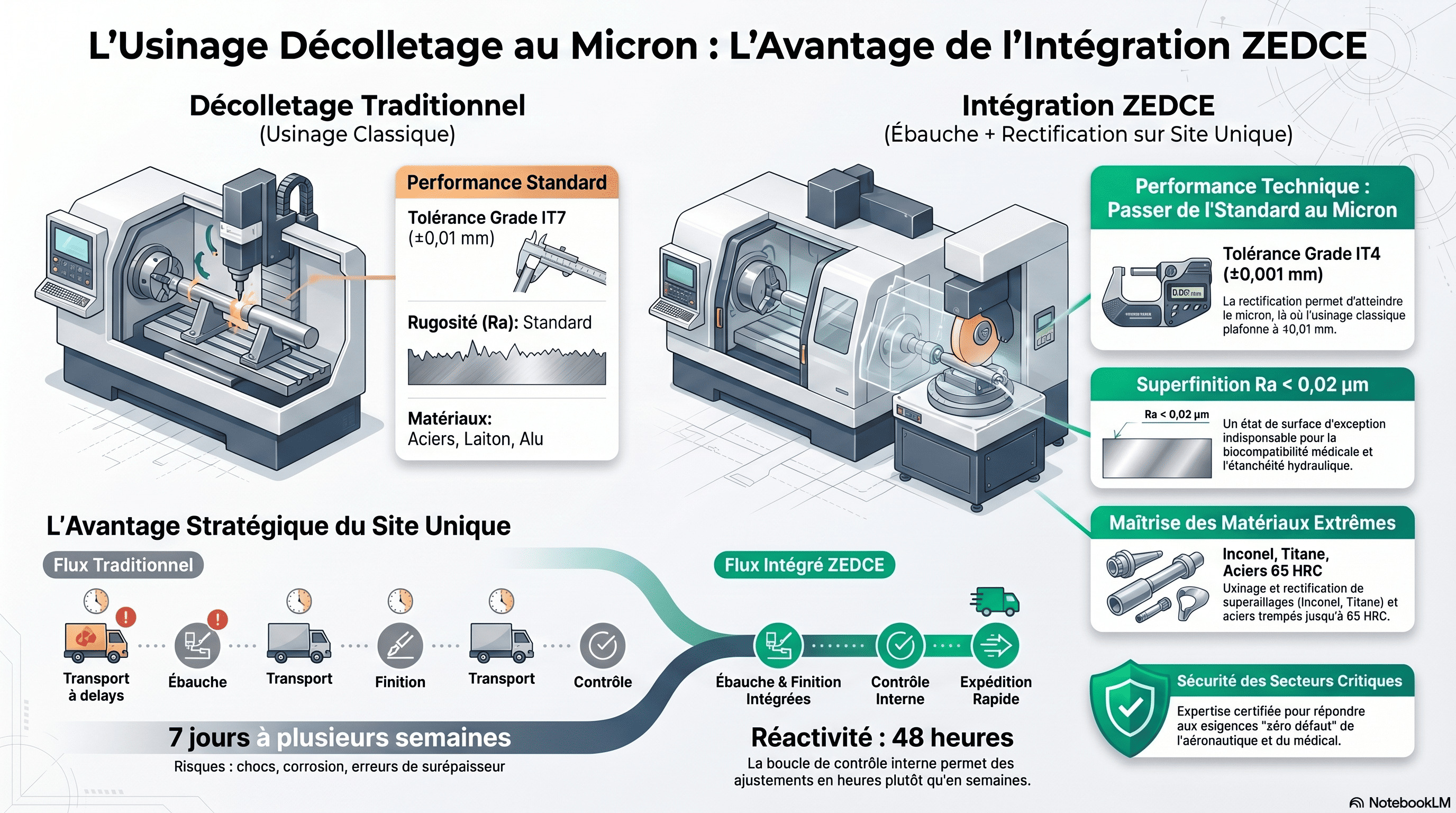
- Moving from an IT7 machining grade to an IT4 grinding grade allows us to guarantee micrometric tolerances down to ±0.001 mm.
- Superfinishing operations ensure exceptional surface finishes, achieving an Ra roughness of less than 0.4 µm, and even down to below 0.02 µm.
- Our expertise includes machining highly demanding materials, such as hardened steels (60 to 65 HRC), Ti6Al4V titanium, or Inconel 718, which are particularly difficult to produce when micrometric precision is required.
- Consolidating roughing and finishing phases at a single site significantly reduces risks related to logistics or quality, such as impact damage, lead time delays, or errors in calculating machining allowances.
- You secure your most complex developments by relying on long-standing expertise deeply rooted in the Arve Valley ecosystem.
The Arve Valley: the benchmark ecosystem for French precision turning

The Arve Valley has built an international reputation thanks to a unique industrial expertise: precision turning. Since the 19th century, local workshops have continuously perfected the art of bar turning, giving rise to an incomparable industrial network.
To illustrate this momentum, the National Precision Turning Syndicate (SNDEC) reported a total of 635 specialized companies in France in 2019, 69% of which were concentrated in Haute-Savoie, generating a total turnover of 2.3 billion euros.
This remarkable density translates into an impressively efficient network. Within a radius of just 30 kilometers, you can find raw material suppliers, heat and surface treatment experts, and cutting tool distributors. It is this dense fabric that has established the Valley's precision turning industry as a global benchmark for 150 years.
However, the traditional landscape has shifted. The production of simple, high-volume parts (such as small screws or basic pins), characterized by IT7 tolerances (from ±0.01 to ±0.02 mm), has largely been offshored. Today, the true added value of the Arve Valley lies inhigh-precision turning and machining.
What precision machining really means in 2026
The very term "turning" can be reductive today. While it once referred to simple, high-speed, continuous metal bar turning for mass production, the contemporary reality is far more complex.
At ZEDCE, this process is no longer limited to bar work. We deploy a fully integrated production chain. This combines multi-axis CNC turning on Nakamura machines equipped with Y-axes and sub-spindles to handle complex geometries, secondary operations on blanks or castings, and milling on HAAS centers.
Furthermore, this chain incorporates ultra-high-precision grinding stages, which are among the most reliable processes for ensuring micron-level tolerances in repeatable production. This comprehensive approach elevates our craft to that of a manufacturer of high-value-added components.
Why is CNC machining alone not enough for micron-level precision?
In repeatable industrial production, a CNC lathe generally reaches its limits around the IT6-IT7 grade. These limits are difficult to exceed consistently in an industrial environment due to mechanical spindle play, thermal expansion caused by cutting speeds, and natural tool wear that alters geometry. While these parameters are perfectly suitable for the standard automotive industry, they are prohibitive for hydraulics (which require a perfect seal) or aerospace (which is sensitive to material fatigue).
This is where micrometric grinding shows its full potential. Unlike turning, the action of an abrasive wheel removes infinitesimal amounts of material thanks to its micro-grains. This specific process makes it possible to target tolerances in the micron range (typically corresponding to the IT4 grade depending on the dimensions involved), achieve Ra roughness values that can reach (in certain specific superfinishing cases) less than 0.02 µm, and ensure perfect statistical consistency across an entire series. To guarantee this level of precision, ZEDCE has invested in a fleet of state-of-the-art grinding machines (Kellenberger, Diskus, Stähli), which form the pillar of our value chain.
ZEDCE's industrial capabilities: the advantage of integration
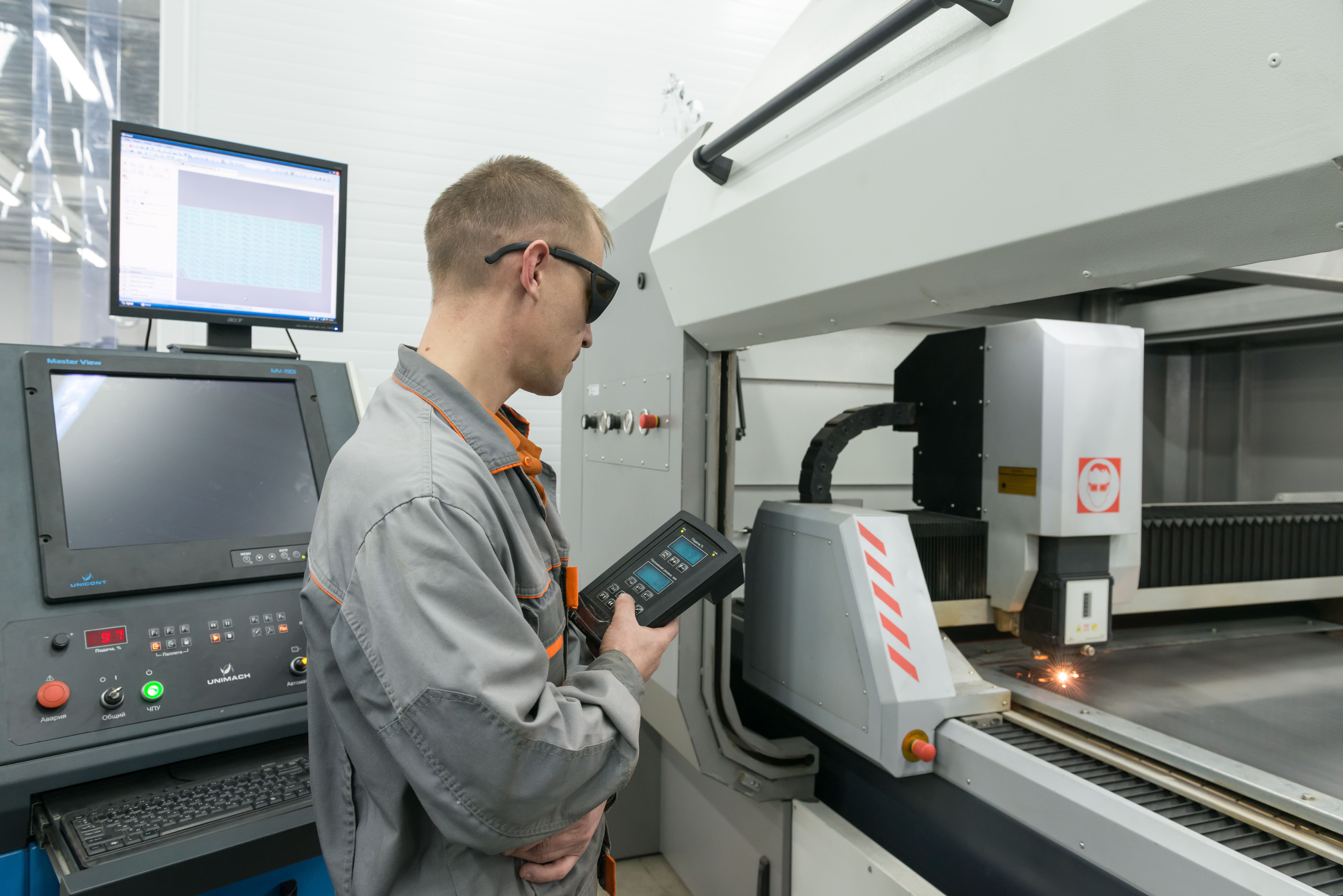
Based in Marnaz since 1946, our company has deliberately stepped away from the race for low-cost volume. We have built a 9,000 m² facility where roughing, finishing, and inspection phases are seamlessly integrated under the guidance of a single methods department. This organizational symbiosis makes all the difference for sensitive projects.
Our production facility brings together over a hundred pieces of equipment : Nakamura CNC lathes capable of handling diameters from 10 to 200 mm, HAAS machining centers automated by Stäubli robotic cells, and a comprehensive grinding workshop. To validate our processes, our metrology laboratory is equipped with coordinate measuring machines (CMMs) and contour tracers, ensuring continuous monitoring through statistical process control (SPC) while documenting every first article inspection (FAI).
Full integration allows us to avoid the pitfalls associated with fragmented subcontracting. When machining and grinding are performed at two separate sites, several issues consistently arise: machining allowances are often miscalculated due to a lack of coordination, transit exposes parts to impact or corrosion, and any production drift takes several days to be corrected by the initial site.
At ZEDCE, the same team defines the roughing allowances and oversees the grinding process. If our statistical tools detect thermal drift, the correction is applied in hours rather than days, which guarantees on-time delivery, full compliance and significant material savings.
Materials expertise: from standard steels to superalloys
Our expertise covers a very wide range of industrial materials, adapted to the most stringent requirements:
Regarding superalloys in particular (Inconel 718, titanium Ti6Al4V), themachining and bar turning alone quickly reaches its limits when micrometric requirements and critical surface finishes are needed. The heat generated by machining, combined with the low thermal conductivity of these materials, creates a risk of burning that compromises mechanical properties. Final grinding with a CBN (cubic boron nitride) wheel becomes non-negotiable.
Case studies: proof through integration
The theory of a fully integrated production site truly proves its worth when faced with industrial demands. The following two examples illustrate how the immediate synergy between our machining and grinding departments resolves technical deadlocks, secures quality, and drastically optimizes production lead times.
The challenge of the hydraulic cylinder rod
Imagine producing 5,000 316L stainless steel cylinder rods, with an 8 mm bore, a strict IT4 tolerance (±0.001 mm), and an Ra roughness of less than 0.1 µm to ensure a proper seal.
If a primary subcontractor machines the part, they will generally achieve a diameter of 8.012 mm (IT7). The part then undergoes 2 to 3 days of transport to a grinding specialist, who may discover an excess material error before finally succeeding in the operation, bringing the total lead time to 7 or 10 days.
Thanks to ZEDCE's integrated model, the process is seamless. The turning stage intentionally leaves a diameter of 8.015 mm, a dimension perfectly optimized for our grinding machines. Cylindrical grinding follows immediately to bring the part to 8.0005 mm. The result: controlled production delivered in two days under SPC monitoring and a recurring saving of 0.015 mm of material per part.
Critical machining of an Inconel 718 shaft for the aerospace industry
An engine manufacturer requested the production of 500 aged Inconel 718 shafts (at 65 HRC) with a 6 mm diameter, requiring a tolerance of ±0.0005 mm and an Ra roughness below 0.2 µm.
Conventional machining alone quickly reaches its limits given the material's hardness and low thermal conductivity, as the heat could alter the part's metallurgical properties and would never allow for repeatable IT4 grade results.
ZEDCE's technical solution involves two stages: initial machining with TiAlN-coated carbide tools under very high-pressure coolant to cool the Inconel, followed immediately by grinding with a special CBN wheel to remove material gently. If necessary, superfinishing completes the process to deliver a component with intact properties. This level of expertise allows us to deliver a part deemed unachievable by traditional channels within 3 to 4 weeks.
Sectors of excellence in ultra-high precision
Our expertise is specifically tailored to industries where failure is not an option. When safety or overall performance depends on a component, guaranteeing an IT4 grade and an optimal surface finish becomes an absolute imperative.
ZEDCE has been supporting major sectors for decades with dedicated equipment:
- Aeronautics: We manufacture engine components and fasteners in Inconel and titanium. This sector tolerates no defects and requires full traceability. ZEDCE is currently in the process of obtaining EN 9100 certification.
- The vacuum market: We play a critical role in the production of spectrometer motors. Our expertise covers the manufacturing of the central shaft, which is fully machined, ground, and assembled with its bushings. This component supports blades rotating at tens of thousands of revolutions per minute; at such extreme speeds, even a micron outside of tolerance creates a destructive imbalance that can instantly render the motor inoperable.
- Hydraulics: This is the field where our expertise truly shines. For valves or pistons operating at 200 to 400 bars, the slightest surface roughness leads to leaks, and the smallest geometric deviation causes premature seal wear. We consistently guarantee IT4 or IT5 grades for these applications.
Why choose an integrated French partner?
Unit production cost is only one aspect of a project's competitiveness. Relying on a partner based in Haute-Savoie offers guarantees far superior to distant alternatives :
- Logistical security: Working with ZEDCE reduces lead times to 1 or 2 weeks, compared to 8 to 12 weeks for offshore options. This allows you to avoid the uncertainties of maritime freight and the risks of supply chain disruptions.
- Operational efficiency: By centralizing machining, finishing, and metrology, we provide you with a single point of contact, whereas fragmented subcontracting increases the risk of errors and communication delays.
- Intellectual property protection: Your blueprints and machining strategies remain within European territory, protected by strict confidentiality standards, which shields you from the risks of data exposure in Asia.
- Flexibility: Adjusting your product range or volume is easy, without the hassle of container-based replenishment.
Entrust your machining projects to ZEDCE
If your specifications involve challenging materials, complex geometries, or micrometer tolerances, ZEDCE is your trusted partner. We manage the entire cycle, from CNC roughing to compliant delivery, including grinding and quality control.
Please feel free to send us your drawings (PDF or STEP formats). Our methods department will analyze your request to provide a feasibility study and a detailed quote within 24 to 48 business hours.
Contact us for a free consultation at +33 (0)4 50 98 05 56.
FAQ: The essentials of our processes
What is the principle of bar turning?
The principle of bar turning involves mass-producing turned parts through material removal. Machining is performed using a metal bar that advances continuously (or is fed) into a lathe. Cutting tools then "peel" away the material in the form of chips to shape the part. Today, this process is controlled by CNC (Computer Numerical Control) and allows for a sequence of complex operations (turning, milling, drilling) with extremely high precision.
How is modern bar turning defined?
While bar turning historically referred to the rapid turning of a bar, ZEDCE’s approach is more comprehensive. We combine highly complex CNC turning with secondary operations, milling, and grinding to deliver parts with micrometer-level precision.
Why is grinding essential for the aerospace industry?
This sector requires micrometric tolerances and extremely low surface roughness, which can reach Ra 0.02 µm in certain superfinishing cases. These demanding levels generally exceed the repeatable capabilities of traditional machining alone.
Is prototyping possible with these processes?
Absolutely. Prototyping replicates the exact process planned for mass production, using the same tools and grinding passes, which perfectly secures technical feasibility before launching full-scale production.
.jpg)



.webp)
.webp)
.webp)