What is Nital? Composition and use in metallography

Validating a grinding process requires ensuring material integrity beyond simple dimensional compliance. Nital etching (ASTM E407) reveals the microstructure of steels and detects grinding burns invisible to the naked eye. By integrating this standardized non-destructive testing (MIL-STD-867, AMS 2649) into its metrology protocols, Zedce certifies the absence of thermal damage and guarantees the absolute reliability of your critical high-precision components.
What is Nital? Composition and use in metallography
Validating a machining or grinding process is never limited to dimensional compliance; material integrity matters just as much.
The Nital is precisely the tool used to verify it. It is the most widely used chemical etching reagent in metallography, consisting of nitric acid diluted in alcohol, designed to reveal the microstructure of steels and cast irons.
It is, in fact, a standardized formulation, referenced in the international standard ASTM E407 for microstructural etching reagents. This article details its composition, common concentrations, laboratory applications, operating procedure, essential safety precautions, and its key role in post-grinding quality control.
Key takeaways:
- Nital is an etching reagent composed of nitric acid (HNO₃) diluted in alcohol (ethanol or methanol), at a common concentration of 1 to 5%.
- It is the standardized reference formulation (ASTM E407) for revealing the microstructure of carbon steels and low-alloy steels.
- It reveals the grain boundaries of ferrite, pearlite, martensite, and internal phases, making it possible to identify the heat treatments applied.
- A 2% concentration is sufficient for most common steels ; beyond 5%, safety risks increase significantly.
- A mixture of ethanol and nitric acid becomes potentially explosive above 10% acid by mass.
- For post-grinding quality control, Nital is the standardized method (MIL-STD-867, AMS 2649, ANSI/AGMA 2007-C00) to detect grinding burns invisible to the naked eye.
- Thermally damaged areas appear dark gray, blue, or black after etching, while a healthy surface remains light gray or light brown.
- Safety requires a strict mixing order : always pour the acid into the alcohol, never the other way around, and work under a fume hood with appropriate PPE.
- For stainless and high-alloy steels, other reagents (Vilella, Marble's reagent) are more appropriate than Nital.
What is Nital? Definition
Nital is the most common etching reagent in metallography for the analysis of carbon steels and low-alloy steels. Its name is a contraction of its two components: NITric acid + alcoHOL.
Its role is to create optical contrast between the different phases and grains of the alloy, in order to make them observable under a microscope. On a mirror-polished surface, the eye distinguishes nothing; after etching with Nital, grain boundaries and metallurgical constituents appear clearly. Thanks to this contrast, the metallographer can identify and characterize the microstructural constituents of the part.
The Nital is among the named formulations in ASTM E407 (Standard Practice for Microetching Metals and Alloys), making it a recognized standard in metallurgy laboratories everywhere.
Nital composition

The formulation of Nital, while seemingly simple, actually requires absolute precision to ensure reliable testing during your metrology laboratoryanalyses.
The two components
Its composition is based on two complementary ingredients: nitric acid (HNO₃), which causes chemical oxidation of the surface, and alcohol (ethanol or methanol), which controls the kinetics and ensures uniform etching. This combination guarantees reliable revelation of the microstructure.
Typical concentrations
Standard concentrations range from 1% to 5% nitric acid by volume, with 2% being the most common all-purpose formulation used in standard laboratory settings for carbon steels. The choice depends on the nature of the grade and the specific metallographic objective.
For mild and low-treated steels, a 1-2% solution is sufficient. This is increased to 3-5% for quenched and tempered or case-hardened steels, which are more resistant to chemical etching. The table below summarizes the applications.
Methanol or ethanol: two complementary approaches
The choice of alcohol is significant. Ethanol is the most widely used in laboratories due to its moderate reactivity and better handling profile. However, when mixed with nitric acid at concentrations above 10%, it poses a significant risk of explosion.
Methanol, on the other hand, offers more stable solutions that are less prone to explosion. Its major drawback is its increased toxicity, particularly through inhalation and skin contact, making it less practical in an open laboratory environment.
In practice, ethanol remains the preferred choice for extemporaneous preparations in standard laboratories at low concentrations. Conversely, ready-to-use commercial solutions are often formulated with methanol to leverage its chemical stability and simplify storage and handling.
What is Nital used for in metallography?
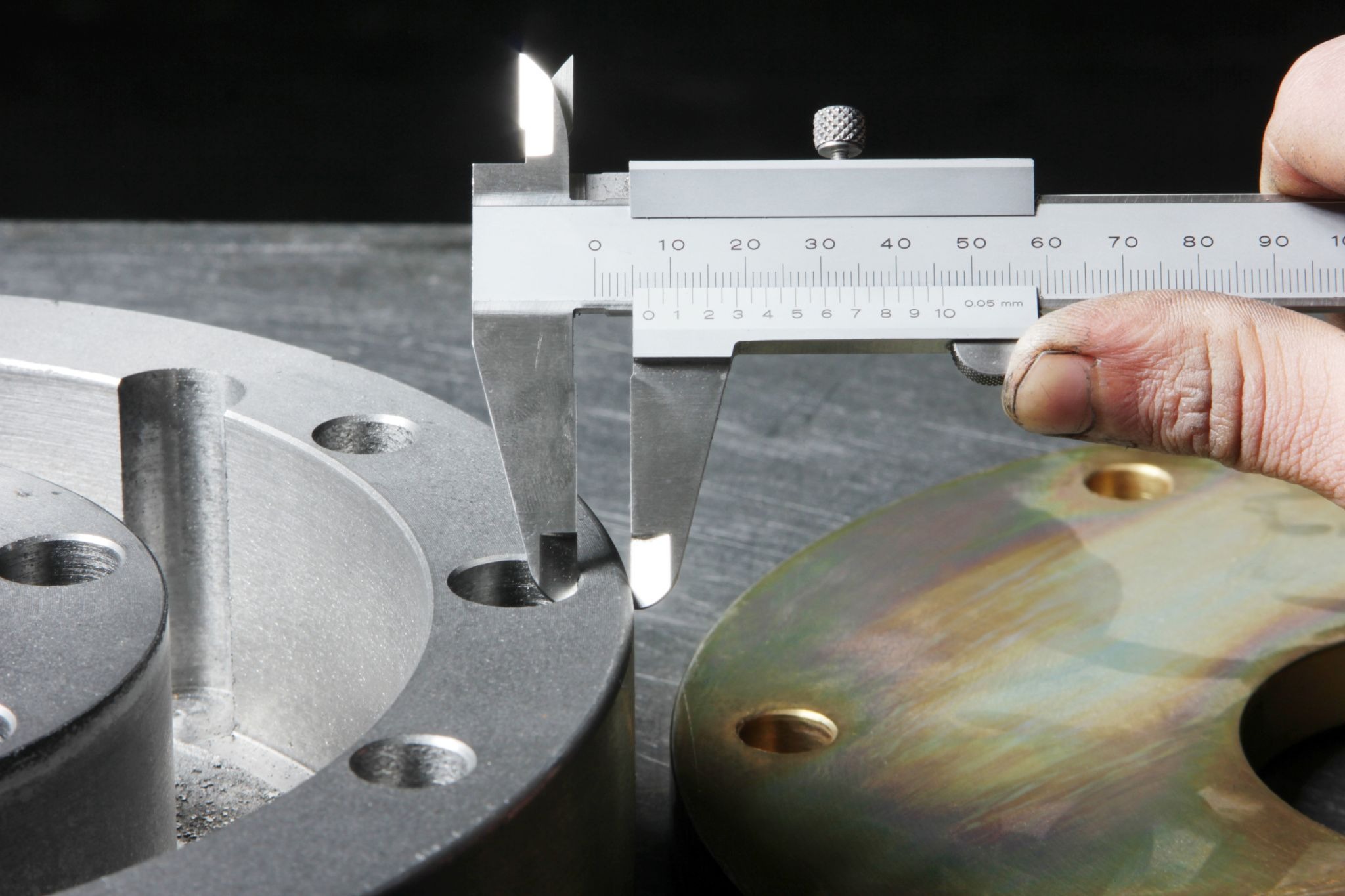
In metallography, Nital is the essential chemical reagent for validating the conformity of the internal structure of steels after machining operations, grinding, or heat treatment. Its action makes the invisible visible under a microscope, ensuring strict compliance with the mechanical performance requirements of your critical industrial components.
The principle of chemical etching
Etching is based on a simple principle: the reagent does not react identically across all areas of the alloy. Grain boundaries, which are higher in energy, and the various phases exhibit distinct dissolution rates. Consequently, certain areas become more deeply etched or darkened, creating the relief and contrast that make the microstructure visible under a microscope.
Revealed constituents and their interpretation
Each constituent responds differently to Nital. Ferrite shows sharp, dark grain boundaries, while pearlite, cementite, martensite, and bainite exhibit distinct morphologies depending on their hardening state. This differentiation allows for a direct assessment of the heat treatments applied. The Nital remains the standardized reagent (ASTM E112) for measuring ferrite grain size in the laboratory.
Other inspection applications
Beyond routine observation, Nital is also used to analyze decarburization depth or carburization, to examine heat-affected zones (HAZ) in welds and to inspect cast iron.
How to use Nital? Operating procedure
Successful etching relies primarily on methodical preparation of the sample.
The typical steps are as follows:
- Mirror polishing of the surface to be examined (pre-polishing followed by fine polishing stages);
- Cleaning and degreasing to remove any trace of residue;
- Etching by immersion or swabbing using a cotton swab;
- Rinsing with water followed by alcohol;
- Drying quickly (using a hot air jet) to prevent staining.
A successful etch is indicated by a surface that has become matte and uniform. In the event of under-etching (structure too pale, lacking contrast), simply extend or repeat the process. In the event of over-etching (surface too dark, details obscured), the sample must be re-polished and the process repeated with a shorter duration.
Nital etching and grinding burn inspection
This is one of the most strategic industrial applications of Nital and a key concern for any high-precision grinding workshop.
Thermal risk in grinding
High-precision cylindrical or surface grinding generates intense localized heat at the point of contact with the grinding wheel. If cooling is not perfectly controlled, the surface can suffer from "grinding burn" or grinding burn : localized overheating that causes over-tempering or even re-hardening of the area. The problem is that this defect is usually invisible to the naked eye on a finished part.
The detection protocol (non-destructive testing)
Nitaletching, known in this context as Nital etch test or temper etch (temper inspection), is now considered the gold standard for detecting these burns.
Over-tempered areas exhibit reduced hardness and accelerated etching kinetics, resulting in more pronounced darkening. This difference in appearance is immediate and reproducible: a grinding burn produces a dark gray to black tint, while the healthy surface retains a light gray or light brown color. In cases of mild burns, the contrast can be subtle; inspection must therefore be performed under standardized lighting (min. 200 footcandles according to ANSI/AGMA 2007-C00) to avoid any diagnostic errors.
This non-destructive testing method is governed by several recognized industrial specifications, notably MIL-STD-867 and AMS 2649 (etch inspection of high-strength steel parts), as well as the ANSI/AGMA 2007-C00 standard for ground gears.
It is essential for critical applications (aerospace, engines, gears, hydraulics) where thermal defects cannot be tolerated, as a burn irreparably compromises fatigue life.
Our precision grinding and integrated quality control ensure this rigorous compliance.
Safety precautions

Corrosive and flammable, Nital requires a rigorous safety approach at every stage, from preparation to storage:
- Mandatory PPE: acid-resistant gloves, safety goggles, lab coat;
- Work under a fume hood: nitric acid vapors are irritating and toxic;
- Critical mixing order: always add the acid to the alcohol slowly, never the other way around;
- Instability risk: concentrated solutions (especially above 5%) can become explosive; above 10% acid by mass in ethanol, the risk is significant. Nital should therefore be prepared in small quantities and used immediately;
- Storage: airtight bottle, in a cool, ventilated area, away from any heat sources and combustible materials;
- Disposal: Acidic waste must be neutralized and disposed of in accordance with hazardous waste regulations.
For all handling, it is recommended to refer to the product's Safety Data Sheet (SDS) and the recommendations of an organization such as theINRS.
Nital or other metallographic reagents: how to choose?
For standard steels, Nital is essential. However, specific materials such as stainless steel, superalloys, and high-alloy steels require different reagents.
In summary, Nital is chosen to observe ferrite grain size or the general structure of standard carbon steel. Picral is preferred for fine structures (fine pearlite, bainite), while Vilella or Marble's reagent is used for stainless and high-alloy steels. This selection logic is even more critical for specific materials like 316L stainless steel or titanium, which require dedicated etching approaches.
Securing the quality of your machined parts with Nital
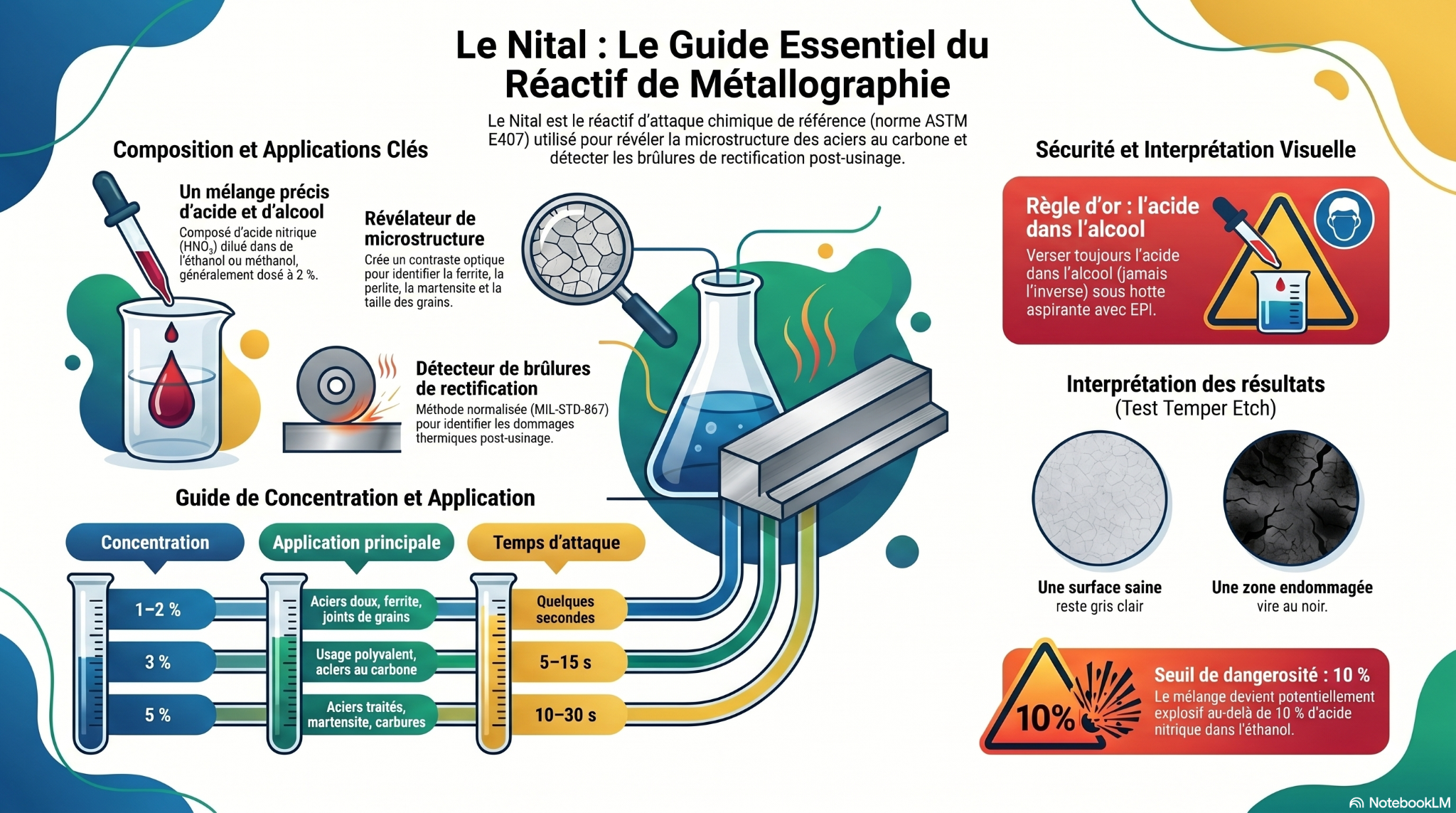
Nital is a strategic metallographic reagent for analyzing the thermomechanical history of steelsIt reveals the microstructure, metallurgical transformations, and grinding burn damage that are imperceptible during conventional inspections. However, rigorous control of its formulation, concentrations, and operating procedure is essential to ensure the reliability of the diagnostics.
Integrated into a formal quality control program, the Nital etch test helps certify the structural integrity of critical components. This approach, combined with three-dimensional measurement and statistical process control (SPC)techniques, is an essential driver of compliance for high-precision applications.
Do your parts require integrated expertise? Grinding and metrology solutions from Zedce guarantee the integrity of your critical production runs. Contact us for a personalized assessment.
FAQ - Your questions about Nital
What is the composition of Nital?
Nital is composed of nitric acid (HNO₃) diluted in alcohol (ethanol or methanol), typically at a concentration of 1 to 5%. The acid is the active agent, while the alcohol acts as the solvent to regulate the etching process.
What is Nital used for?
It is used to reveal the microstructure of steels and cast irons (ferrite, pearlite, martensite, grain boundaries) through chemical etching, both in metallography and industrial quality control, particularly for detecting grinding burns.
Which Nital concentration should I choose?
For most carbon steels, a 2% solution is sufficient. You can increase to 3–5% for treated steels, which are more difficult to reveal. Beyond 5%, safety risks increase significantly.
Does Nital etch stainless steel?
No, or very little. Nital is designed for carbon and low-alloy steels. Stainless steels, which are resistant to nitric acid, require other reagents such as Vilella's or Marble's reagent.
Can Nital be stored for a long time?
It is best to prepare it in small quantities just before use. Concentrated solutions can become unstable or even explosive; prolonged storage is not recommended for safety reasons.
What is the difference between Nital and Picral?
Nital etches ferrite grain boundaries and acts quickly. Picral is slower and primarily reveals fine structures (pearlite, bainite) without pitting ferrite boundaries, making it a complementary reagent to Nital.
Is Nital dangerous?
Yes. It is a corrosive and flammable product, and concentrated solutions can be explosive. Handling it requires PPE, a fume hood, and strict adherence to the mixing order (acid into alcohol).
.jpg)



.webp)
.webp)
.webp)